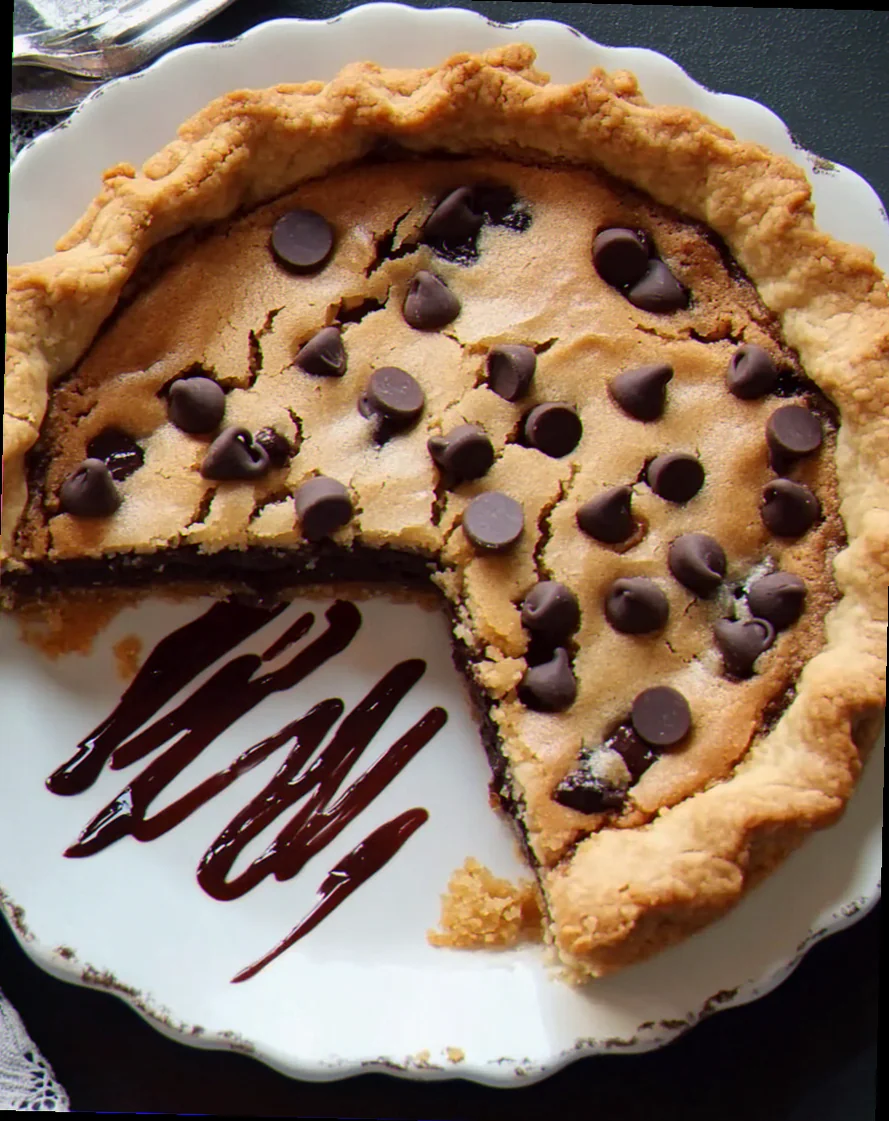
The most common failure in a PC-style chocolate chip cookie pie is Raw Middle Syndrome, where the perimeter of the pie is overbaked and brittle while the center remains a liquid, unappetizing slurry of raw flour and melted fat. This diagnostic guide identifies the structural and thermal imbalances that lead to this failure and provides the precise technical fixes to ensure a uniform, fudgy, and stable crumb.
What Perfect Chocolate Chip Cookie Pie Actually Looks, Feels, and Tastes Like
Before troubleshooting, you must recognize the benchmark. A successful cookie pie is not simply a large cookie; it is a hybrid of a blondie and a shortbread, requiring a specific internal architecture to support its own weight.
| Stage | Success marker — what you should see / feel / smell / hear |
|---|---|
| Raw Dough Phase | The dough is matte, tacky but not sticky, and holds its shape when pressed into the pan. It should smell intensely of vanilla and molasses. |
| Mid-Bake (approx. 20 min) | The edges have risen and turned a light “biscuit” tan. The center is puffed and opaque, not shiny or wet. Internal temp: 65°C. |
| The Finish (out of oven) | The “Jiggle Test”: The center should have a slight, rhythmic wobble like set custard, but no “sloshing” movement. Internal temp: 79°C–82°C. |
| Post-Rest (2 hours) | The center has slightly recessed. When sliced, the knife comes out with moist crumbs but no raw batter. The flavor is a balance of toasted butter and salt. |
The Ingredient Failures — Wrong Choices Before You Even Start Cooking
- The Grease Slick (Fat Separation): caused by using margarine or low-fat “tub” spreads instead of high-fat block butter → fix: Use 82% butterfat unsalted butter, softened to exactly 20°C (cool to the touch, but leaves a fingerprint).
- The Dry Crumb (Structure Failure): caused by using only granulated white sugar, which lacks the hygroscopic properties of molasses → fix: Use a 2:1 ratio of light brown sugar to granulated sugar to ensure moisture retention and a chewy “fudge” center.
- The Rubbery Set (Protein Overdrive): caused by using “Extra Large” eggs or too much egg white → fix: Use 2 “Large” eggs (approx. 50g each). If the dough seems too liquid, omit one egg white and use only the yolk to increase fat content without adding water.
- The Grainy Mouthfeel: caused by using refrigerated, cold chocolate chips that don’t temper with the dough → fix: Ensure chocolate chips are room temperature (21°C) before folding them in to prevent localized “cold spots” in the batter.
The Technique Failures — What Goes Wrong During Cooking
- The Volcanic Collapse: The pie rises significantly in the oven then craters in the middle → caused by Over-Creaming. Beating the butter and sugar for more than 3 minutes incorporates too much air, which the heavy dough cannot support → fix: Cream butter and sugar for exactly 2 minutes on medium speed until combined but not “fluffy.”
- The Bread-Texture Cookie: The pie is tough and elastic rather than tender → caused by Over-Mixing the flour, which develops gluten → fix: Fold in the flour by hand using a silicone spatula just until no white streaks remain. Stop immediately.
- The Scorched Top / Raw Bottom: The top is dark brown but the base is doughy → caused by incorrect rack positioning → fix: Bake on the lower-middle rack of the oven. This ensures the bottom of the pan receives the most direct heat, cooking the base through before the top sugars caramelize.
- The Seized Chocolate Pocket: Small clumps of bitter, dry chocolate → caused by adding chocolate chips while the butter-sugar mixture is still warm from over-friction or melted butter → fix: Ensure the base mixture is below 23°C before adding chips.
The Equipment Failures — When Your Tools Are the Problem
- Glass vs. Metal Pans: Using a glass pie dish often results in The Pale Bottom because glass is an insulator and takes longer to heat up. If using glass, you must increase bake time by 5–8 minutes. For the most consistent “PC-style” crust, use a dark, non-stick metal tart or pie pan.
- The Oven Calibration Error: Most home ovens are off by 10–15°C. A cookie pie is dense; if the oven is too hot, the outside burns before the heat reaches the center. Use an independent oven thermometer to verify a steady 165°C (325°F).
- The Hand-Whisk Failure: Attempting to cream cold butter by hand usually results in Fat Pockets, leading to holes in the finished pie. Use a stand mixer with a paddle attachment or an electric hand mixer.
The Full Recipe — Built Around Preventing Every Failure Above
- Unsalted Butter (82% fat) — 170g — Prevents the Grease Slick; must be 20°C.
- Light Brown Sugar — 150g — Prevents the Dry Crumb and provides chew.
- Granulated White Sugar — 75g — Provides the crisp perimeter.
- Large Eggs — 2 (100g total) — Prevents the Rubbery Set.
- Vanilla Extract — 10ml — High dosage to mask floury notes.
- All-Purpose Flour (10-11% protein) — 280g — Prevents The Soggy Pavement; provides structural integrity.
- Baking Soda — 1 tsp — Provides the rise; do not substitute with baking powder or you will get a “cakey” failure.
- Sea Salt — 3/4 tsp — Prevents The Salt Bomb (table salt is too fine and will make it too salty).
- Semi-Sweet Chocolate Chips — 250g — High cocoa butter content ensures a smooth melt.
Method:
- Creaming: Combine butter and both sugars. Beat for 120 seconds. — Prevents Volcanic Collapse — success marker: Mixture looks like wet sand, not whipped cream.
- Emulsifying: Add eggs and vanilla one at a time. — Prevents Split Batter — success marker: A smooth, cohesive gold paste.
- Dry Integration: Sift flour, baking soda, and salt directly into the bowl. Fold by hand. — Prevents Bread-Texture Cookie — success marker: A heavy, thick dough that requires effort to stir.
- The Fold: Add chocolate chips. Fold 5 times only. — Prevents Seized Chocolate — success marker: Even distribution without breaking chips.
- The Press: Transfer to a 9-inch metal pie pan. Press down firmly, especially at the edges. — Prevents The Soggy Pavement — success marker: An even, flat surface with no air gaps.
- The Bake: Place in a 165°C oven for 25–30 minutes. — Prevents Raw Middle Syndrome — success marker: Internal temperature reaches 80°C at the dead center.
How to Rescue the Pie When It Has Already Gone Wrong
- If the edges are dark but the center is liquid: Immediately cover the pie loosely with aluminum foil (shiny side up) to deflect heat from the top. Lower the oven temperature to 150°C and bake for an additional 10 minutes. This allows the center to “catch up” without burning the crust.
- If the pie is “weeping” oil: This means the emulsion broke. You cannot fix the dough now, but you can save the texture. Blot the top with paper towels and immediately move the pie to the freezer for 15 minutes post-bake. This “shocks” the fat back into a solid state, preventing a greasy mouthfeel.
- If the pie is rock-hard once cooled: It was overbaked. To rescue, slice the pie and store it in a sealed container with a slice of fresh white bread for 4 hours. The cookie will absorb the moisture from the bread, returning it to a soft, “PC-style” state.
- If it’s a catastrophic crumble: If the pie completely falls apart when sliced because it’s too dry, crumble the entire thing into a bowl, mix with 2 tablespoons of melted butter, and press it into a new pan to form a “cookie crust” for a cheesecake or silk pie.
Make-Ahead: Which Failures This Introduces and How to Avoid Them
Making the dough ahead is actually beneficial, but introduces two specific risks:
- The Dehydration Failure: Cold air in the fridge strips moisture. Fix: Wrap the dough in the pie pan tightly with two layers of plastic wrap, ensuring no surface area is exposed.
- The Thermal Shock Failure: Baking a stone-cold pie in a hot oven results in a burnt exterior and a frozen interior. Fix: If the dough has been refrigerated, let it sit at room temperature for 60 minutes before putting it in the oven.
Related topics: Simple recipe for chocolate pie · Serious pie biscuit recipe · Tomato pie bisquick recipe
Diagnostic FAQ
My pie turned out “cakey” and light instead of dense — what went wrong?
You likely used Baking Powder instead of Baking Soda, or you over-creamed the butter. Baking powder contains an acid and a base, causing a chemical lift that mimics cake. Use only Baking Soda for that dense, fudgy PC-style texture.
It looked right but tasted like “flour” — where did I go wrong?
This is an Under-Extraction Failure. You likely pulled it out too early (below 75°C) or failed to add enough salt. Salt is the catalyst that makes the sugar and vanilla “pop.” Increase sea salt by 1/4 tsp next time.
Everything looked perfect until I sliced it — why did it fall apart?
You failed the Resting Phase. A cookie pie is essentially a giant heat-sink. The residual heat continues to cook and set the starches for up to 90 minutes after leaving the oven. Slicing it while hot causes the unset fats to run. Wait at least 2 hours.