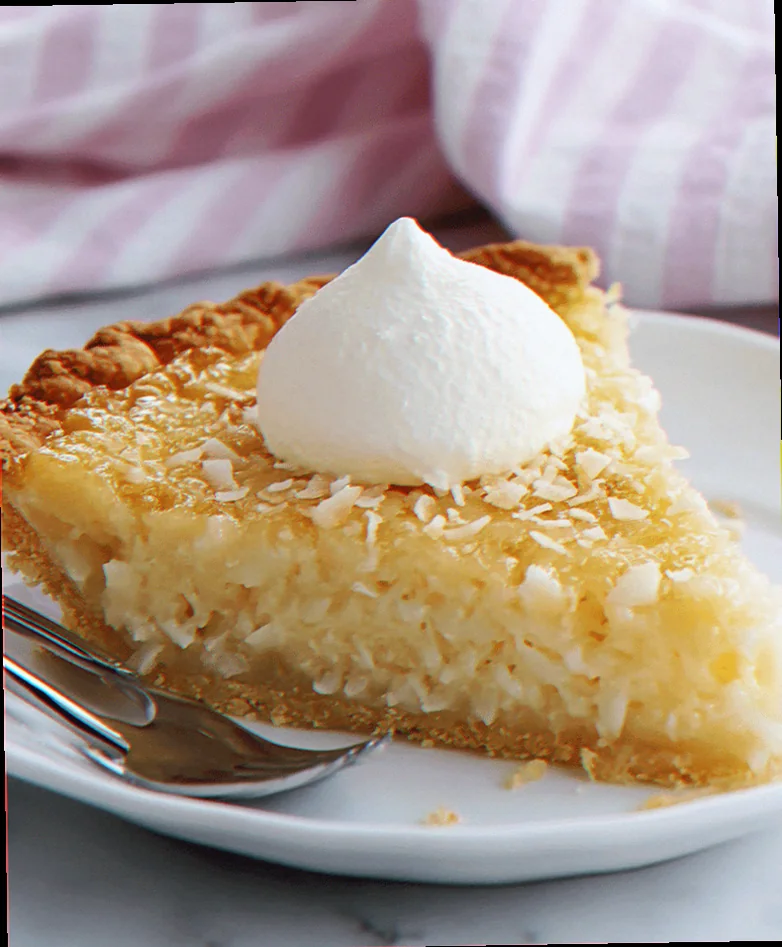
The most common catastrophic failure of a coconut pie is The Slump—a structural collapse where the filling, instead of holding a sharp, proud edge when sliced, oozes across the plate in a lukewarm puddle of coconut-scented soup. This failure occurs because the starch was never fully hydrated or was broken down by egg enzymes, and this guide is designed to diagnose that specific chemical breakdown along with every other mechanical failure from a soggy base to a weeping meringue.
What Perfect Coconut Cream Pie Actually Looks, Feels, and Tastes Like
Before diagnosing your failures, you must understand the benchmark of a successful set. A perfect coconut cream pie is a study in structural integrity disguised as cloud-like softness.
| Stage | Success marker — what you should see / feel / smell / hear |
|---|---|
| The Raw Custard | A pale, ivory slurry that smells intensely of fatty coconut; it should be completely smooth with no grit when rubbed between fingers. |
| The Thickening (82°C–85°C) | The mixture transitions from a liquid to a heavy, “lava-like” viscosity; bubbles should pop slowly and audibly (glup-glup) on the surface. |
| The Set (Post-Chilling) | The surface should have a gentle, uniform jiggle when the pan is tapped, but no “waves” or liquid movement beneath the top layer. |
| The Slice | A knife should pass through with minimal resistance, leaving a clean, vertical wall of custard that does not sag or leak moisture onto the plate. |
The Ingredient Failures — Wrong Choices Before You Even Start Cooking
- The Oil Slick (Fat Separation): caused by using low-quality, “light,” or stabilized carton coconut milk instead of high-fat canned coconut milk → fix: use canned coconut milk with a minimum of 17% fat content; shake the can vigorously before measuring to re-incorporate the coconut cream.
- The Gritty Bite: caused by using “Desiccated” coconut without rehydrating or using large, sweetened “Flake” coconut in the filling → fix: use “Finely Shredded” sweetened or unsweetened coconut; for the filling, smaller particles ensure the starch matrix isn’t interrupted by woody fibers.
- The Graying Crust: caused by using low-protein cake flour which lacks the structure to hold back the moisture of the custard → fix: use All-Purpose flour with exactly 10.5%–11.5% protein content to create a sturdy, moisture-resistant barrier.
The Technique Failures — What Goes Wrong During Cooking
- The Soggy Bottom: The crust is limp, pale, and damp → caused by “Moisture Migration” where the custard’s water content soaks into an underbaked or unsealed crust → fix: “Blind bake” the crust at 190°C until fully golden, then brush with a thin layer of beaten egg white and bake for 2 more minutes to create a waterproof protein shield.
- The Enzyme Soup: The filling thickens on the stove but turns to liquid in the fridge → caused by “Amylase Attack,” where the alpha-amylase enzyme in egg yolks isn’t neutralized by heat, allowing it to eat the cornstarch → fix: You must bring the custard to a full boil for exactly 60–90 seconds; the heat must reach 85°C to denature the enzymes and fully “gelatinize” the starch.
- The Grainy Curdle: Tiny, rubbery bits of cooked egg throughout the cream → caused by “Thermal Shock” when hot milk is dumped too quickly into cold eggs → fix: “Temper” the eggs by whisking in only 120ml of the hot coconut milk at a time until the egg mixture is warm to the touch before returning it to the main pot.
- The Weeping Cloud: Beads of moisture forming between the custard and the topping → caused by “Syneresis” or applying topping to a cold pie → fix: If using meringue, apply it while the custard is still piping hot (above 70°C) so the bottom of the meringue “cooks” onto the filling, creating a molecular bond.
The Equipment Failures — When Your Tools Are the Problem
- The Thin-Bottomed Pot: Causes “Localized Scorching” where the bottom layer of custard burns before the middle is thick → fix: Use a heavy-bottomed stainless steel or enameled cast iron saucepan for even heat distribution.
- The Glass Pie Plate: Glass is an insulator and slow to heat, often leading to an underbaked bottom crust even if the edges look done → fix: Use a dull-finish metal pie tin for the crispest crust, or increase baking time by 10 minutes if using glass.
- The Whisk vs. Spatula: Using only a spatula leaves “Starch Pockets” in the corners of the pan → fix: Use a balloon whisk to keep the mixture in constant motion, ensuring every starch granule is hydrated and no lumps form.
The Full Recipe — Built Around Preventing Every Failure Above
The Foundation (Crust)
- All-Purpose Flour — 160g — [Provides protein structure to prevent the “Crust Collapse”]
- Unsalted Butter (Cubed and Chilled to 4°C) — 115g — [Ensures steam pockets for flakiness; warm butter causes a “Mealy Crust”]
- Ice Water — 45ml — [Cold temp prevents gluten over-development]
- Egg White (for sealing) — 1 large — [Prevents “Soggy Bottom” moisture migration]
The Filling (The Structural Custard)
- Full-Fat Canned Coconut Milk — 400ml — [High fat prevents “The Oil Slick” separation]
- Whole Milk — 240ml — [Balances the coconut fat to prevent a “Heavy/Greasy” mouthfeel]
- Granulated Sugar — 150g — [Hygroscopic nature keeps the custard tender]
- Cornstarch — 40g — [The primary structural agent; prevents “The Slump”]
- Egg Yolks — 4 large — [Provides emulsification and richness; prevents “Liquid Leakage”]
- Finely Shredded Coconut — 100g — [Small particle size prevents “The Gritty Bite”]
- Vanilla Extract & Salt — 5ml / 2g — [Flavour stabilizers]
Method:
- Blind Bake the Shield: Roll and fit the crust. Weight it with ceramic beads and bake at 190°C. Remove weights when edges are set. Success marker: The bottom should look dry and opaque. Brush with egg white and bake 2 mins more to seal.
- The Starch Slurry: Whisk sugar, cornstarch, and yolks in a bowl until pale. Failure prevented: This coats the starch in fat/sugar, preventing “Lump Formation” when heat is applied.
- The Tempering: Heat coconut milk and whole milk until it reaches 80°C (steaming, but not rolling boil). Slowly whisk 1/3 of this into your egg mixture. Success marker: The egg mixture should feel warm and look like a thin milkshake.
- The Critical Boil: Pour the tempered eggs back into the pot. Whisk constantly over medium heat. When it starts to bubble, keep whisking for 90 seconds. Success marker: The custard will suddenly transition from liquid to a thick, glossy gel that coats the back of a spoon. Failure prevented: This kills the Amylase enzyme that causes “The Slump.”
- The Fold: Remove from heat; stir in shredded coconut, vanilla, and butter. Pour into the hot crust.
- The Seal: Immediately press plastic wrap directly onto the surface of the custard. Failure prevented: This prevents a “Rubbery Skin” from forming due to evaporation.
How to Rescue Coconut Pie When It Has Already Gone Wrong
- If the custard won’t thicken on the stove: It likely hasn’t reached the 82°C threshold. Continue cooking and whisking vigorously. If it still won’t thicken, mix 1 tbsp cornstarch with 2 tbsp cold milk (a slurry) and whisk it in, then boil for 1 minute.
- If the filling is “Soupy” after 4 hours of chilling: This is a catastrophic starch failure. Rescue: Do not try to re-bake. Scoop the filling into a bowl, fold in 250ml of whipped heavy cream, and serve it as “Coconut Mousse” in glasses. It will not hold a slice, but it will taste correct.
- If the crust is burnt but the filling is perfect: Carefully scrape the filling out into a fresh, pre-baked tart shell. The heat of the filling will help it bond to the new crust.
Make-Ahead: Which Failures This Introduces and How to Avoid Them
The primary failure of make-ahead coconut pie is Crust Softening. Over 24–48 hours, even a sealed crust will absorb ambient moisture.
- The Protocol: Store the pie in the refrigerator at 4°C, but do not add the whipped cream topping until the hour of serving.
- Avoid: Never freeze a coconut cream pie. Freezing breaks the starch bonds in the custard; upon thawing, the pie will suffer “Total Syneresis,” where the water separates from the solids, leaving you with a spongy mass in a pool of water.
Related topics: Skinny coconut cream pie recipe · Pudding bottom peach pie recipe · Dump recipe for chicken pot pie
Diagnostic FAQ
My pie turned out “Rubbery”—what went wrong?
This is caused by Over-Starching. If you measured your cornstarch by volume (tablespoons) rather than weight (grams), you likely used too much. Next time, use a digital scale.
It looked perfect but tasted “Soapy”—where did I go wrong?
This is an Ingredient Quality Failure. Old shredded coconut contains fats that go rancid, producing a soapy or metallic aftertaste. Always taste your coconut flakes before adding them to the pot.
Everything looked perfect until I sliced it—why did the crust shatter?
This is Gluten Over-Development. You likely overworked the dough or added too much water. The crust became a “Sheet of Glass” rather than flaky. Handle the dough as little as possible and ensure the butter remains in visible, pea-sized chunks.